The book that I have chosen for this blog is Meditations by Marcus Aurelius. The reason that I chose this book originally was because I thought that my thesis would encompass certain ideas relating to the Roman Empire, and so I thought that researching a philosophical text written by one of the emperor’s of the time would offer a unique insight into that topic. However, my topic has changed and evolved since then and so I still chose to keep this book because after reading the book, I realized that it still offered significant insight about ethics (and especially the ethics of being a good leader) that would be helpful for my thesis.
In this Blog, I hope to accomplish a clear discussion on several ethical topics discussed in Aurelius’s book, as well as how to relates to contemporary ethical issues. In my first four posts, I will focus on summarizing the book, and in my last four posts, I will focus on analyzing a couple of ethical issues and how it relates to the book, as well as the discussions/readings from our class.
How do we live our lives thinking that they ‘matter’ if we all at the end of the day, will perish? This is such an intriguing and thought provoking topic that many philosophers struggle to answer. On the Biblical/religious side, the answer is quite apparent, being in order to live in accordance with God’s will. But, due to the uncertainty and unpredictability of life, how do we establish the significance to our own (albeit short in the grand scheme of things) life.
Biblical Perspective
In Romans, it states:
“If we live, we live for the Lord; and if we die, we die for the Lord. So, whether we live or die, we belong to the Lord.”
Romans 14:8
Therefore, the purpose of life and death is established: this being for carrying out the will of God. Therefore, there is purpose to life and death according to the biblical perspective, that being of following in accordance with the will of God. In revelation, in particular, it paints the picture of the afterlife.
“And I heard a loud voice from the throne saying, “Look! God’s dwelling place is now among the people, and he will dwell with them. They will be his people, and God himself will be with them and be their God. ‘He will wipe every tear from their eyes. There will be no more death’ or mourning or crying or pain, for the old order of things has passed away.”
Revelation 21:3-4
Therefore, the Bible offers comfort by adding that people who die will be reunited with God and so the fear of death is lessened. However, despite the Biblical perspective, (as well as the potential threat of hell) how exactly do we add value/worth to our current lives?
Aurelius’ perspective
I think that Aurelius has an excellent answer to this dilemma. In book 11, Aurelius states,
“The external things whose pursuit or avoidance trouble you do not force themselves on you, but in a way you yourself go out to them. However that may be, keep your judgement of them calm and they too will stay still — then you will not be seen either to pursue or to avoid.”
Aurelius 108
Aurelius in this way offers his advice on how to tackle the world without committing the aforementioned sins of being in pursuit of the good while avoiding suffering. In this way, by remaining calm, the external ‘things’ that exert magnetic forces toward you will be subsided. Aurelius also states,
“Live through life in the best way you can. The power to do so is in a man’s own soul, if he is indifferent to things indifferent.”
Aurelius 109
In this way, Aurelius argues that we should all try to be the best version of ourselves, and that we are all fully capable of doing so. Therefore, despite the eminent threat of death looming in the background, we should all still try to live life the best way that we can.
Final thoughts
Overall, I agree with both the Biblical and Aurelius’ perspectives on how to cherish life and death. I think that the Bible teaches a lot on how to understand death and to not fear it, and Aurelius teaches a lot on how to live day-to-day with the correct mindset. In this way, I argue that this is a better alternative to the ‘YOLO’ slang that is pretty popular among people of my age which stands for ‘You only live once’ which has become the rationale to not care for the value of life and death and to be in full pursuit of pleasure with the avoidance of pain. I think that more people should learn from religious texts such as the Bible, and as well as through Aurelius’ Meditations in order to fully understand and treasure the value of life and death.
So far in these blog posts, we have discussed the ethics of obtaining justice (peace versus violence) and how to classify sin. In this blog, I hope to synthesize these two blogs and apply them to environmentalism; the debate in Individualism vs. communalism and it’s implications. One topic that we discussed in our Biblical Heritage class was vegetarianism and the Biblical justifications of eating meat, but also eating ethically in general. One thing that one of my classmates brought up in our group forum was that it is incredibly difficult for a ‘broke’ college student to eat ethically. Because college students are not necessarily making their own money yet and all their expenses go toward tuition/living, they do not necessarily have the luxury to eat ethically. This classmate specifically stated that she didn’t care enough to find out about the origins of her groceries (how they were produced/whether it was produced ethically or not) but rather just cared about the price. In this modern day world, as I discussed in my previous blog, it has become incredibly difficult to not commit any sins/to be ethical because of consumerism and capitalism, even the act of buying something as simple as a tomato, can be sinful.
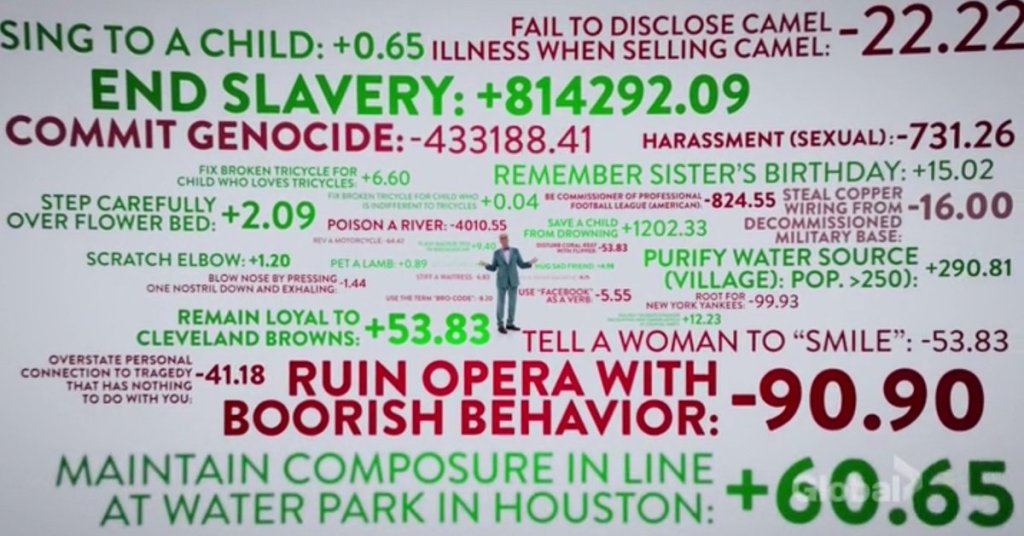
An picture from the TV show The Good Place on showing how the ‘points-system’ works.
In this clip from the Good Place, Michael, one of the ‘bad place’ architects, or essentially one of the people who designs hell, tries to explain to the ‘judge’ or essentially a ‘Jesus’ type of character who has the authority to give the final verdict, how incredibly difficult it has become to not acquire ‘bad points’ or essentially, to commit sins. Similar to the thoughts of my classmate, Michael explains how in the action of purchasing a tomato from the grocery store, automatically means that the person is unknowingly/unwittingly supporting toxic pesticides, exploiting labor, etc. Therefore, one of the questions to consider while reading this post, is how much should we care about the environment, and to what extent should something be considered in the ethics of environmentalism. Along the theme of environmentalism, another question to consider would be to what extent should we focus on the individual, and to what extent should we sacrifice for the community (or environment)?
Bible Perspective
In Genesis, God makes a covenant with Noah and states the following:
“Then God said to Noah and to his sons with him, “Behold, I establish my covenant with you and your offspring after you, and with every living creature that is with you, the birds, the livestock, and every beast of the earth with you, as many as came out of the ark; it is for every beast of the earth. I establish my covenant with you, that never again shall all flesh be cut off by the waters of the flood, and never again shall there be a flood to destroy the earth.”
Genesis 9:8-11
Depiction of Noah’s Arc
In this passage, God clearly promises that he will not cause another flood/any kind of damage to his creation (all the living creatures of the earth). However, as there still have been various natural disasters, could this be argued that in terms of the biblical perspective, these natural disasters were onset by human actions? For example, with heavy pollution, climate change, which is a natural phenomenon, has become more of a human-induced change and has resulted in the rapid warming of the earth. In this case, the question would then be, how exactly would we tackle this issue? Since it involves the entire planet and all the living species, would this become a community-driven issue?
Aurelius’s Thoughts
Justice, as previously discussed in blog number 5, pertains to acting for the sake of the cosmopolis according to Aurelius. So how does this factor into Environmentalism? According to Aurelius, as people must work together for the greater good, I think that this concept can easily be applied to environmentalism. As just now discussed in the biblical perspective, environmentalism is a community-level concern which dictates the responsibility for all citizens of the world (according to Aurelius) to work together to eliminate the threat. In this way, Aurelius would argue that since the good of the planet is in the interest of the cosmopolis, then it would be a sin/an act of injustice to not help in taking care of the planet.
Final Thoughts:
Overall, as we can see from both the Bible’s perspective and from Marcus Aurelius, environmentalism is an important issue, and helping the environment is of the greater interest of all peoples of the world, which is why we should focus more on the community as a whole rather than the individual. In this way, rather than it becoming only the burden of certain individuals to chose to care about the environment, if it becomes a social construct that all people (and companies) are working together to help, then the problems of not being able to afford the luxury of eating ethically no longer becomes an issue.
As a continuation from my last post, I will try to discuss what constitutes as a sin. In this day and age, it has become pretty difficult to discern what exactly constitutes as a sin/sinful activity. For example, in the television show,The Good Place, one of the problems that the show highlighted was how incredibly difficult it is to get into the ‘good place’ or their version of heaven. This is because, due to advancements in technology and other reasons, it has become incredibly difficult to perform any action without it resulting in some form of sin. This brings us to the question: what exactly qualifies as a sin?
Biblical Perspective
In order to first tackle this subject, lets first look to the Biblical perspective on sin. In Romans, Paul states,
They have become filled with every kind of wickedness, evil, greed and depravity. They are full of envy, murder, strife, deceit and malice. They are gossips, slanderers, God-haters, insolent, arrogant and boastful; they invent ways of doing evil; they disobey their parents;they have no understanding, no fidelity, no love, no mercy. Although they know God’s righteous decree that those who do such things deserve death, they not only continue to do these very things but also approve of those who practice them.”
Romans 1:29-32
From this excerpt, Paul attributes certain qualities to sinners, and therefore lists examples of different sins. The main thing to highlight here though is that these sinners here not only commit these sins, but are also well aware that the actions that they are partaking in are sinful, yet they still do it anyway. This is especially important because it relays the important concept of self-awareness and how the intentions behind each action can be as sinful as the action itself. Paul also brings to attention the significance of laws and how they can help make people become more aware of what sinful actions consist of. Paul states,
“All who sin apart from the law will also perish apart from the law, and all who sin under the law will be judged by the law. For it is not those who hear the law who are righteous in God’s sight, but it is those who obey the law who will be declared righteous.”
Romans 2:12-13
Therefore, Paul is implying that there are sinful actions apart from disobeying the law (and therefore the law of the land cannot necessarily cover all sins) and so simply just being aware of the law will not equate to righteousness, rather following the law and not committing any sinful actions apart from the law. However, it is not the law who governs total authority; rather God’s will. Paul states,
“Now we know that whatever the law says, it says to those who are under the law, so that every mouth may be silenced and the whole world held accountable to God. Therefore no one will be declared righteous in God’s sight by the works of the law; rather, through the law we become conscious of our sin.”
Romans 3:19-20
Thus, the law serves mainly as a rough guideline of rules to follow, but there are still other rules that should be followed that fall outside the jurisdiction of the ‘law’ but are still governed by the supreme authority; God.
Aurelius’ Thoughts
Now that we’ve covered what the Bible’s perspective of sin is and who the main/final authority is, let’s now discuss what Marcus Aurelius’s thoughts are. Following the discussion from my previous post on justice, Aurelius expands this discussion to include the topic of sin. Aurelius states at the beginning of Book 9,
“Injustice is sin. When universal Nature has constituted rational creatures for the sake of each other–to benefit one another as deserved, but never to harm — anyone contravening her will is clearly guilty of sin against the oldest of the gods; because universal Nature is the nature of ultimate reality, to which all present existence is related.”
Aurelius 83
In this excerpt, Aurelius, in a different way from the Bible, establishes sin as the human behavior which divulges from the main constitution of universal Nature–being to live for the sake of each other and to help and not harm each other. In this way, it is similar to the Christian concept of ‘loving your neighbor’ but is still different from the Christian perspective of sin. This is because for one, the final authority in this case is characterized as the ‘universal Nature’ however, despite being personified slightly, is more of a framework of the human existence. In this way, by following the natural framework of human existence, a person by this definition is not committing any sins and is living a righteous life. Therefore, in contrast to the typical Christian belief of human nature of being ‘bad’, Aurelius posits the idea that human nature, or the rational being, is inherently good. Aurelius also adds,
“Moreover, the pursuit of pleasure as a good and the avoidance of pain as an evil constitutes sin. Someone like that must inevitably and frequently blame universal Nature for unfair distribution between bad men and good, since bad men are often deep in pleasures and possessions which make for pleasure, while the good often meet with pain and the other circumstances which cause pain.”
Aurelius 83
Essentially, Aurelius is arguing that the act of deliberately pursuing only pleasure and avoiding any form of suffering constitutes a sin. This is very similar to the Christian concept of suffering in which Romans states
“Not only that, but we rejoice in our sufferings, knowing that suffering produces endurance,and endurance produces character, and character produces hope, and hope does not put us to shame, because God’s love has been poured into our hearts through the Holy Spirit who has been given to us.”
Romans 5:3-5
Therefore, suffering and pain is a virtue and the avoidance of this would be a sin.
Final Thoughts
Overall, I think that it can be difficult to discern what constitutes a sin from a virtue when it comes down to the minor details of every action, but according to the Bible and Aurelius, following the law (as well as the laws of nature) and being aware of your actions (and it’s effects–therefore being aware if you are committing a sin and choosing not to commit it) as well as not avoiding suffering are all the guidelines to living a righteous life. In this way, although we did not clearly classify all the different types of sin, as long as you follow these guidelines, you will not be committing sin.
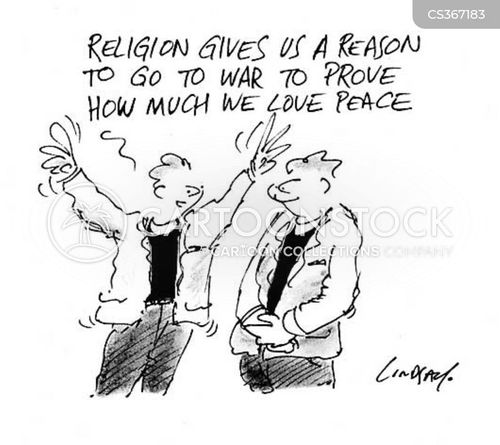
The ethics of peace and war, especially in the current times has become a highly popular topic of contention. The debate on how to perpetuate peace–whether this be through violence (and therefore wars) or through pacifism, is an issue that is widely debated and has yet to be resolved. This was a topic that was also heavily debated in our online class forum, as some people seemed to think that pacifism, although seemingly nice in theory, is impossible to emulate given the circumstances of war. One of the most intriguing arguments made in particular by one of my classmates was that war is not morally equivalent on both sides, and so violence/fighting is not completely ‘evil’ as it can be a means to an end. The example that this classmate gave was that of Christians who participated in World War I, who did not believe in the concept of taking another person’s life, still participated in non-combat roles, still helping in the war, without compromising on their values.
However, I believe differently. I personally think that despite war not being morally equivalent on both sides (as some can take part in having some level of basic human decency), both sides are still morally culpable to some degree. But even with the World War I example, fighting was only a temporary fix. Germany was still disappointed with their defeat and was still wanting more, and so the events lead up to World War II. The fighting during World War II didn’t necessarily end there, and relations/tensions between different countries and ideas of communism versus democracy came about, and throughout the 1900-present day, we have had a long string of various different wars (which did not necessarily all cause each other) but in which fighting/engaging in wars was never really a permanent solution. In some cases, war did help in subduing certain Great Powers (such as Germany and later Russia–to a certain degree) however, it was also other factors that would lead to treaties. So my point is that it may be premature to judge modern day pacifism as a totally realistic way of handling the evils in the world, but it still is possible, however, just not with the current system of international relations that we now have. With that being said, now I will discuss what the Bible’s thoughts on pacifism/war are.
Biblical Perspective
I think that one important source to consider when deliberating on the foundations of violence and just war is one of the oldest traditions; the bible. In chapter 14 of The Moral Vision of the New Testament, Richard Hays questions the compatibility of partaking in violent wars and Christianity. Hays states:
“It may be seen as a sad duty; the church may lament as well as celebrate its dead soldiers. Rarely, however, has the church fundamentally questioned whether military service is consistent with Christian service…Is it appropriate for those who profess to be followers of this gentle shepherd to take up lethal weapons against enemies?”
Hays 317
Essentially, would it be considered the will of God to take up armistice in service of justice? Would it ever be considered just to employ the use of violence as a follower of Jesus? One key text from the Bible to consider is Mathew 5:38-48. In this section, Mathew discusses the importance of not acting in revenge. He states:
““You have heard that it was said, ‘Love your neighbor and hate your enemy.’But I tell you, love your enemies and pray for those who persecute you,that you may be children of your Father in heaven.”
Mathew 43
Even in this mini excerpt, we can see that Mathew takes the concept of ‘loving your neighbor’ to the next level; this applying to love your enemies as well. In this case, it can be inferred that rather than striking the ‘evil doer’ with violence (even if it was in pursuit of justice) it is still not right to act violently but rather lovingly. So if the Bible mainly seems to perpetuate this idea, then how exactly have we been able to justify war? Hays adds to this conversation by stating,
“The New Testament contains important texts that seem to suggest that this question must be answered in the negative, but human experience presents us over and over with situations that appear to require violent action to oppose evil.”
Hays 317-318
In this case, Hays seems to imply that war and the ethics of war cannot be something that is possible to be ever condoned by the Bible, but rather, through the experience of being humans itself, war/violent means will always be imminent.
Aurelius’s Perspective
However, we still haven’t quite answered the main question; how exactly do we justify acts of violence in the defense of justice? In order to delve deeper into this question, let’s consider Marcus Aurelius’s thoughts on the topic. Aurelius, in a simialar manner of Mathew, believes that any act of injustice fulfilling purposes of self-indulgance, or necessarily revenge, is unjust as it divulges from the true nature of human beings. Aurelius states in Book 11,
“Any movement towards acts of injustice or self-indulgence, to anger, pain or fear is nothing less than apostasy from nature. Further, whenever the directing mind feels resentment at any happening, that too is desertion of its proper post. It was constituted not only for justice to men but no less for the reverence and service of god — this also a form of fellowship, perhaps yet more important than the operation of justice.”
Aurelius 112
Essentially, Aurelius, in contrast to Hays, finds any act toward fear, pain, self-indulgence, or anger to be against the nature of the rational human being. Since what much of war boils down to these four categories, he would not be condoning war in this sense. Especially when referring back to the example of World War I, since it was essentially perpetuated by Germany’s fear of a rising Russia, and it’s desire to expand and grow as a central world power (fulfilling two of the categories–fear and self-indulgence) World War I would not be condoned. The other countries (Great Britain, France, and Russia–later the US) would not necessarily be condoned in taking part in the war by this standard because it could be argued that they partook in war due to fear of a rising Germany. However, this logic doesn’t seem to make a lot of sense. How is it that the other countries war against a rising Germany be seen as unjust? Aurelius answers this question. Aurelius states
“Judgement vary of the whole range of various things taken by the majority to be good in one way or another, but only one category commands a universal judgement, and that is the good of the community. It follows that the aim we should set ourselves is a social aim, the benefit of our fellow citizens. A man directing all his own impulses to this end will be consistent in all his actions, and therefore the same man throughout.”
Aurelius 112
Therefore, since Aurelius argues for the justice in acting for the sake of the cosmopolis, or the community, the fighting done by the triple entente, and later the allies in World War II can be justified as they served in the war for the benefit of all life and to serve the purpose of the safety of the world as a whole. In this way, the actions of Great Britain, France, Russia, and later the US can be justified as long as their participation can be seen as consistent with the good of the overall international community.
Final Thoughts:
In this post, I went over the different perspectives on the question of the justification of war/violent means. Even though I still believe that pacifism is still entirely possible, it still cannot always be the answer; similarly, violence cannot always be the answer. In the following blog posts, I plan to explore more on the ideas of acting justly as well as acting in the interest of the cosmopolis.
In this book, Aurelius starts by reminding himself of the maintenance and desires of his soul as well as it’s needs which include
“being which is good and just and beautiful, which generates all things, sustains and contains all things, embraces all things as they dissolve into the generation of others like them.”
Meditations 94
Aurelius, in this way, is still simplifying the needs of the soul in a similar manner of Socrates by emphasizing concepts similar to the ‘True, Good, and Beautiful”. He then encourages himself to take everything with grace and stride. In this sense, he attempts at empowering himself to become obedient to the furthering the agenda of the ‘Whole’ which is to my understanding, synonymous to one’s nature and purpose of life. Much of this book, therefore centers around the concepts of the ‘part’ and the ‘whole’ in which there is a concept of dualism in life, and forming a proper balance is the only way to live the best life according to your nature. Aurelius follows
“The parts of the Whole, all that form the natural complement of the universe, must necessarily perish – and ‘perish’ should be taken in the sense of ‘change’.”
Meditations 95-96
Therefore, the ‘parts’ in this sense are the temporary objectives, and the ‘Whole’ is the main goal of attaining which is understood as constant. Aurelius closes this chapter by emphasizing the needs of the soul, over the needs of the body and that the soul is actually the ‘puppet master’ of sorts behind the ‘puppet’, or the body in this case. Therefore, we must try to become more conscious of our self and its importance over our body’s importance.
In this book, Aurelius lays out the foundation of his philosophical belief and how to apply it to daily life. He first starts with the discussion of how throughout history, it is observable that
“there is nothing new: all things are both familiar and short-lived.”
Meditations 136
Aurelius, in this sense, is trying to link how nothing in the world has never been done, not necessarily thought before. Therefore, there are certain principles which also aren’t new, but also are unchanging. He believes that we should try to recover these principles and to live by them in order to live your life to the fullest. Aurelius then divulges into three criteria that people should follow in order to become the best person, or the best leader. These three being related to the will, action, and perception. If by following these three things, one can achieve peace of the mind, which is required in living your best life.
How live your best life as told by Marcus Aurelius (Book 4)
In this book, Aurelius focuses on the different ways in how to live your best life. He seeks to inform on the most ‘philosophic’ way of treating the self. For instance, he emphasizes the need to live a well ordered life which includes tranquility and free of resentment. In this way, Aurelius takes the position against revenge and resentment, and argues that justice isn’t as vengeful as it may seem, and rather
“tolerance is a part of justice.”
Meditations, 24.
I think that this is especially important because especially during this time (and even now to a certain degree) many conflicts are started as a means of micro-aggression caused from previous resentments. If we were to let go of these resentments, and understand, as Aurelius says, that
“wrongdoing is not deliberate”
Meditations, 24
then we would be on our way to living a peaceful and harmonious life. (Aurelius 24). Aurelius proceeds with this book in providing various aphorisms to further exemplify/put into action several of his main points. I think that something especially worth noting about this book is that Aurelius seems to allude to a 1st level political theory of human nature—being that since humans make up cities, then we should focus on human nature in order to understand the behavior of a city. This political theory in seen in how Aurelius emphasizes the importance of a community’s well-being, attributed to the well-being (and thus rational principles) practiced by the individual human.
Marcus Aurelius’ Oscar’s Acceptance Speech (Book 1)
In the first book, Aurelius lays out paragraphs of different acknowledgments to various people he is thankful for in his life. At a glance it seems as though he is only thanking certain people for how they influenced his life and his moral character, but he also diverges into somehow setting parameters for him to follow. In other words, in how he states all the attributes of his biggest influences, he may be also stating traits of them that he doesn’t necessarily have yet but is striving toward. Aurelius states
“Strength of character—and endurance or sobriety as the case may be–signifies the man of full and indomitable spirit, as was shown by Maximus in his illness.”
Meditations, 8
Overall, the first book serves as a way for Aurelius to both introduce the readers to the different influences in shaping his character, as well as perhaps providing a rubric for how he should be; as well as providing reasons for why he is the way he is.
Director Bong Joon-Ho at the 2020 Oscars
How to be happy: YOLO (Book 2)
This book appears to hold the idea that despite all the problems in life, people should try to remember all the good things in life and not to allow any of the bad things to harm their daily life. Some of the bad things include “people who are meddling, ungrateful, aggressive, treacherous, malicious, unsocial.” (Aurelius 10). In order to combat these ‘evils’, Aurelius suggests to
“Think as if you were on the point of death: ‘you are old; don’t then let this directing mind of yours be enslaved any longer…”
Meditations, 10
Therefore, in order to live without the evils of life clouding your judgment and restricting happiness, Aurelius believes that people should seize the day, and try to understand the value of life, and in doing so, understanding that existence isn’t permanent.
How to be a good leader—Like Nero? (Book 3)
Book three is a continuation of some of the same thoughts present in Book 2. But more than happiness, the focus is on being a good person; the best version of yourself. There is also a sense of urgency presented in this chapter, that the time to become the best version of yourself is now, rather than later when you may be plagued with various old age diseases that prohibits your personal growth. Aurelius states
“Do not waste the remaining part of your life in thoughts about other people, when you are not thinking with reference to some aspect of the common good.”
Meditations, 17
Aurelius emphasizes the importance of thinking of the greater good rather than focusing on isolated situations and the self. In this way, Aurelius hopes for people to
“let the god that is within you be the champion of the being you are…your duty is to stand straight—not held straight.”
Meditations, 19
In this way, Aurelius, more than just educating the average person, is moving toward explaining how to become a good and just leader.
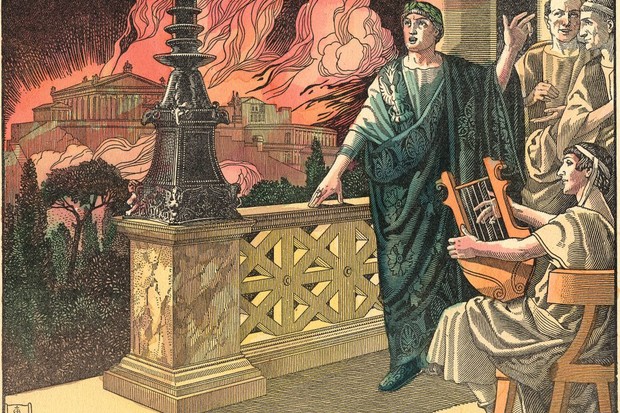
Emperor Nero’s complacency during the burning of Rome







 Meditations--Marcus Aurelius