
Introduction
So far in these blog posts, we have discussed the ethics of obtaining justice (peace versus violence) and how to classify sin. In this blog, I hope to synthesize these two blogs and apply them to environmentalism; the debate in Individualism vs. communalism and it’s implications. One topic that we discussed in our Biblical Heritage class was vegetarianism and the Biblical justifications of eating meat, but also eating ethically in general. One thing that one of my classmates brought up in our group forum was that it is incredibly difficult for a ‘broke’ college student to eat ethically. Because college students are not necessarily making their own money yet and all their expenses go toward tuition/living, they do not necessarily have the luxury to eat ethically. This classmate specifically stated that she didn’t care enough to find out about the origins of her groceries (how they were produced/whether it was produced ethically or not) but rather just cared about the price. In this modern day world, as I discussed in my previous blog, it has become incredibly difficult to not commit any sins/to be ethical because of consumerism and capitalism, even the act of buying something as simple as a tomato, can be sinful.
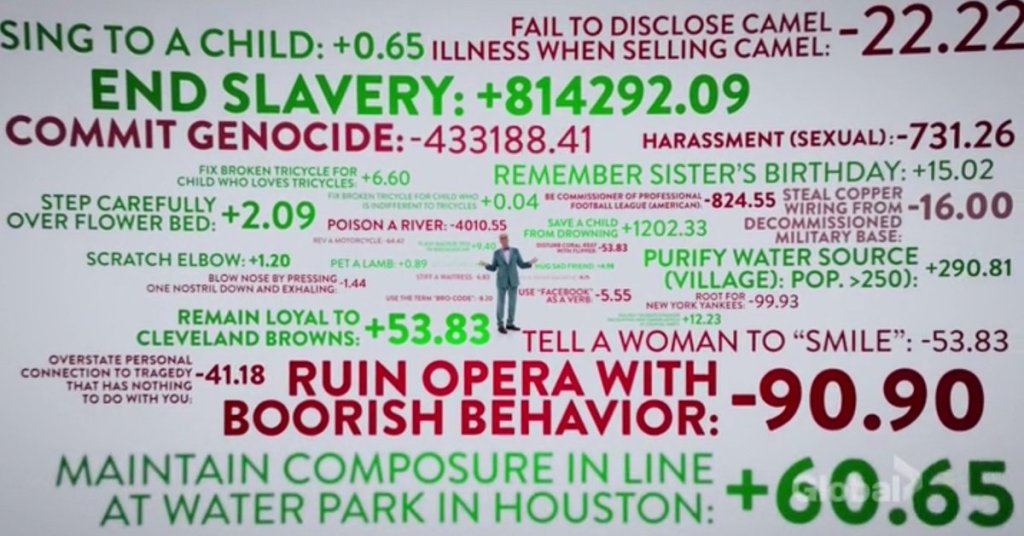
In this clip from the Good Place, Michael, one of the ‘bad place’ architects, or essentially one of the people who designs hell, tries to explain to the ‘judge’ or essentially a ‘Jesus’ type of character who has the authority to give the final verdict, how incredibly difficult it has become to not acquire ‘bad points’ or essentially, to commit sins. Similar to the thoughts of my classmate, Michael explains how in the action of purchasing a tomato from the grocery store, automatically means that the person is unknowingly/unwittingly supporting toxic pesticides, exploiting labor, etc. Therefore, one of the questions to consider while reading this post, is how much should we care about the environment, and to what extent should something be considered in the ethics of environmentalism. Along the theme of environmentalism, another question to consider would be to what extent should we focus on the individual, and to what extent should we sacrifice for the community (or environment)?
Bible Perspective
In Genesis, God makes a covenant with Noah and states the following:
“Then God said to Noah and to his sons with him, “Behold, I establish my covenant with you and your offspring after you, and with every living creature that is with you, the birds, the livestock, and every beast of the earth with you, as many as came out of the ark; it is for every beast of the earth. I establish my covenant with you, that never again shall all flesh be cut off by the waters of the flood, and never again shall there be a flood to destroy the earth.”
Genesis 9:8-11

In this passage, God clearly promises that he will not cause another flood/any kind of damage to his creation (all the living creatures of the earth). However, as there still have been various natural disasters, could this be argued that in terms of the biblical perspective, these natural disasters were onset by human actions? For example, with heavy pollution, climate change, which is a natural phenomenon, has become more of a human-induced change and has resulted in the rapid warming of the earth. In this case, the question would then be, how exactly would we tackle this issue? Since it involves the entire planet and all the living species, would this become a community-driven issue?
Aurelius’s Thoughts
Justice, as previously discussed in blog number 5, pertains to acting for the sake of the cosmopolis according to Aurelius. So how does this factor into Environmentalism? According to Aurelius, as people must work together for the greater good, I think that this concept can easily be applied to environmentalism. As just now discussed in the biblical perspective, environmentalism is a community-level concern which dictates the responsibility for all citizens of the world (according to Aurelius) to work together to eliminate the threat. In this way, Aurelius would argue that since the good of the planet is in the interest of the cosmopolis, then it would be a sin/an act of injustice to not help in taking care of the planet.
Final Thoughts:
Overall, as we can see from both the Bible’s perspective and from Marcus Aurelius, environmentalism is an important issue, and helping the environment is of the greater interest of all peoples of the world, which is why we should focus more on the community as a whole rather than the individual. In this way, rather than it becoming only the burden of certain individuals to chose to care about the environment, if it becomes a social construct that all people (and companies) are working together to help, then the problems of not being able to afford the luxury of eating ethically no longer becomes an issue.
 Meditations--Marcus Aurelius